
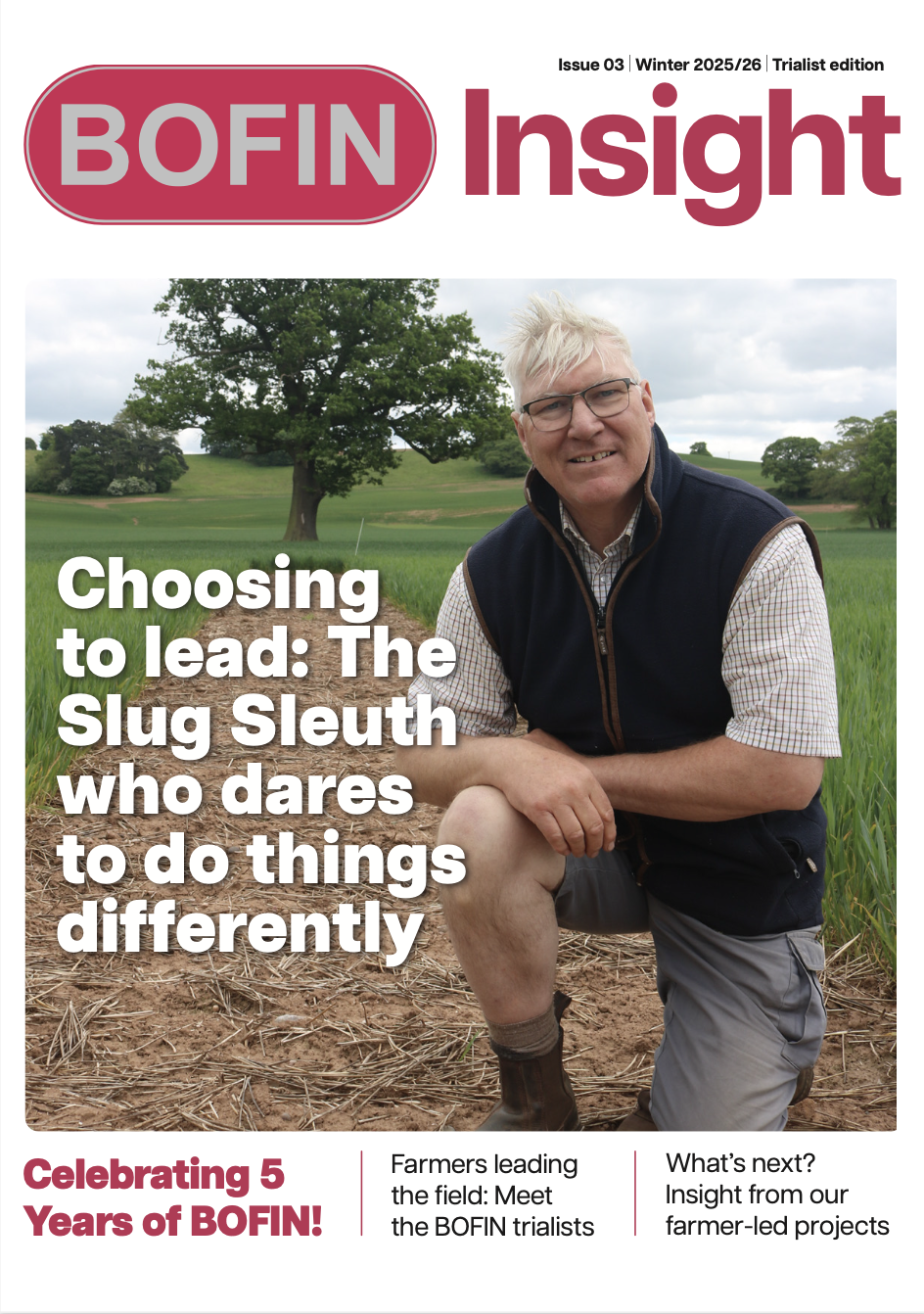
As farm manager for The Morley Agricultural Foundation (TMAF) in Norfolk, David Jones is standing on more than a century of on-farm trials and knowledge exchange and now helping shape what the next century could look like.
The Morley story began 120 years ago when local farmers first began pooling resources to trial new approaches to improve their farming practices. Over the decades, the model evolved from its beginning as the Norfolk Agricultural Station, to become the Morley Research Centre in the 1980s, before splitting into two organisations. The research arm became The Arable Group (TAG) in 200, while the farmland and buildings became today’s charitable foundation. In 2012 TAG then merged with Niab to make a much larger organisation, although the foundation team still works closely with team from TAG.
Now, The Morley Agricultural Foundation (TMAF) farms around 700 hectares including a small amount rented from the John Innes Centre, and donates around £500,000 every year for research and educational projects. The primary aim is for the Morley farm to be commercial, but it also hosts some 30ha of trial plots of wheat, barley, sugar beet and maize. It works closely with Niab, BBRO and the John Innes Centre on those trials with David and his team preparing the plots, and their partners generally carrying out the field work.
He enjoys the opportunity to expand his own knowledge and contribute to the wider industry. “There is so much value in the dialogue between science and farming,” he says. “There is a mountain of opportunity if we can break down the barriers between us.”
He had read about BOFIN and its work to bring scientists and farmers into collaborative projects. “I was keen to get involved and heard they were recruiting for Root Rangers for the TRUTH project. I really liked what they were doing to bridge the gap between science and practical farming so was keen to get involved.
“As farmers we’re good at the above-ground stuff, but there’s so much more to learn about roots and soil. We all have different soil types and conditions and have to make the best decisions we can, so the more information we have the better.”
The idea of using CT scans to understand roots, intrigues him. “We don’t yet know what we’ll learn from it, but that’s the point. You can’t decide the outcome of research before you’ve done it.”
For 2025-26 he has taken his involvement a step further taking on the additional role of PROBITY Pioneer as part of the PROBITY project. This will involve trialling a variety developed through TILLING to test a trait of ‘enhanced gravitropism’ which is believed to result in steeper and deeper roots. If proven valuable the trait could later be introduced through precision breeding.
“There is so much talk about bringing science into farming, and not enough action. Getting involved in the PROBITY project is one way to help change that. I’m very keen to contribute to putting theory into practice and making it work in a commercial situation.”
With this goal in mind David is embarking on a research Masters degree with the University of Nottingham in early 2026. This is based on an ADOPT funded project he is running at Morley which is scaling up plot trials on aphid control in sugar beet.
Alongside the trials and his commercial crops of winter wheat, barley, oats, sugar beet and linseed, David manages maize and rye for an anaerobic digester and drills cover crops before every spring crop. Straw is baled for a local livestock producer and returned as manure, and soil disturbance is kept to a minimum.
“I don’t call myself a regenerative farmer, but I probably am,” he says. “We’ve got diverse cropping, cover crops, apply manure and do minimal ploughing. We’re trying to be as kind to the soil and the environment as we can. It’s easy to say that, but we really are trying.”
For David, regeneration isn’t a label but a mindset of questioning assumptions, looking after the land, and resisting the temptation to believe that every product promises a better crop.
With two employees Gavin Haverson and Sam Filby, a supportive board of trustees, and collaborations with some of the UK’s leading research organisations, David is determined to keep Morley at the forefront of farmer-led research. His involvement in BOFIN is part of his drive to play a part in science and farming learning from one another, with trials that are as much about conversation as they are about data.
“Part of our job is to observe research and work out what’s working and what isn’t,” David concludes. “That’s what keeps farming moving forward. And that’s why I’m excited to be part of BOFIN – it’s another way of making sure the science really meets the field.”
Found in:
Issue #3
Celebrating 5 years of farmer-led innovation
From guesswork to ground truth: mapping the future of pest control
SLIMERS Project advances in the battle against slugs
‘Slug trials’ test nematode application techniques
Wholecrop beans are a win-win for livestock performance and sustainability
Gaining ground with novel wheat lines
Landrace wheats on trial
Rooted in Research
It’s easy to ADOPT, harder to commit