
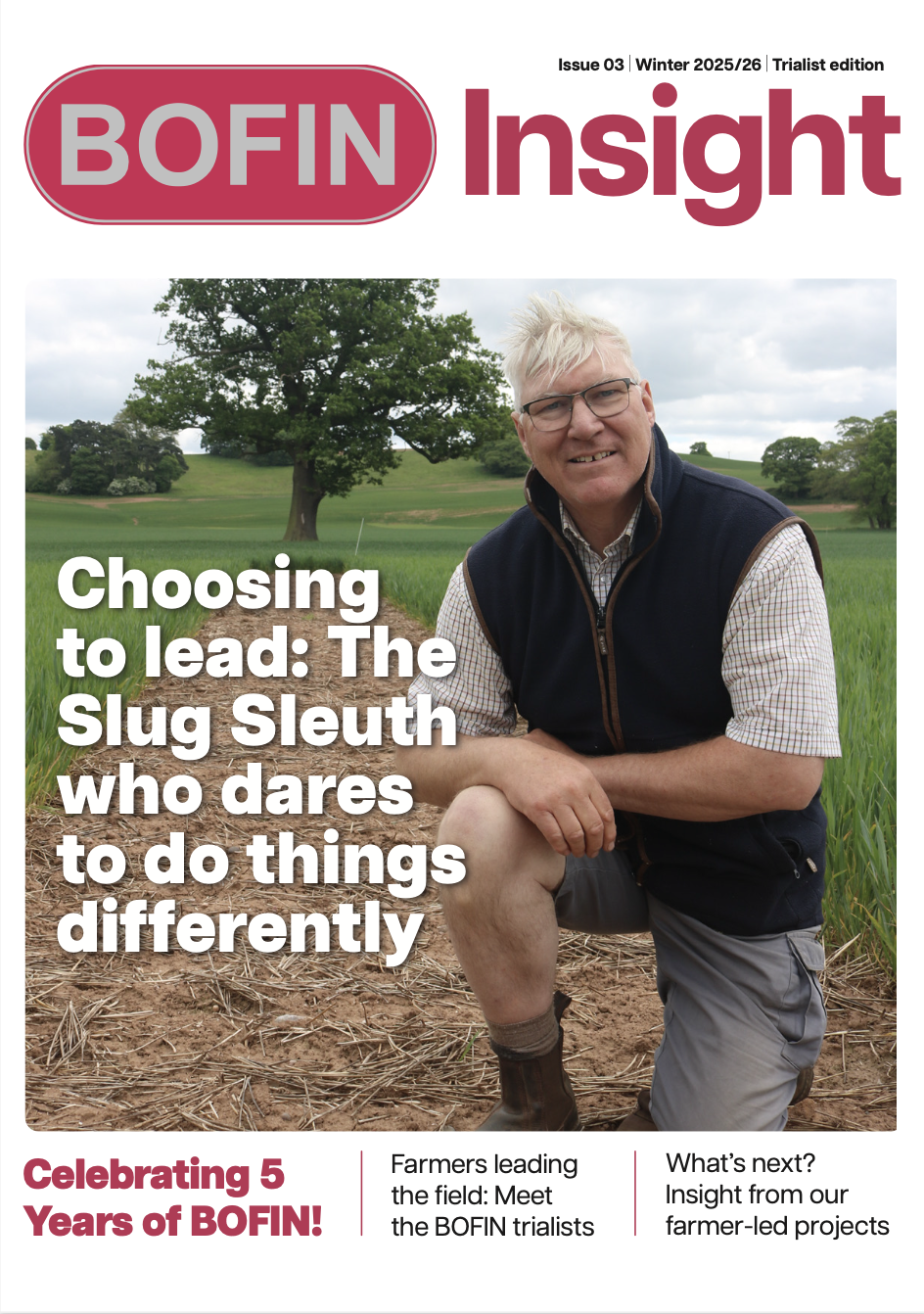
Keen to be a leading force in agricultural innovation, Slug Sleuth Richard Cross is combining tradition with cutting-edge science to push the boundaries of arable farming and slug control – and reaping the rewards of his efforts. By Charlotte Cunningham.
Tucked into the undulating landscape of Nottinghamshire, the Oxton Estate spans 1,215ha of mixed soil types and enterprises. Managed by Richard Cross, the estate reflects a thoughtful blend of modern arable strategy and traditional land stewardship. With a strong focus on soil health, sustainable rotation, and trial-based innovation, Richard is leading a practical but progressive model of UK farming.
“We’ve got two very different soil types here,” Richard explains. “Most of the estate is a heavy red clay that’s good for combinables. About a quarter of the land is Nottinghamshire sands and gravels, which is irrigated and used in rotation for vegetable production.
That duality shapes not just his rotation but his establishment strategy, nutrition plans, and even his growing role in shaping how the industry approaches one of its oldest nemeses: slugs.
The heavy land is largely given over to wheat, winter and spring barley, and, where possible, oilseed rape. “We’ve even tried canary seed,” he says. “Didn’t make us any money, but at least it didn’t lose us any either.”
On the sands, the focus shifts to wheat and maize for AD production in partnership with Severn Trent, punctuated with veg where rotation allows. “It’s two farms in one, really,” Richard explains.
About 728ha are cropped, with the rest of the estate comprising grassland let under grazing licences (182ha) and woodland (182ha). “We manage the woodland for shooting and commercial timber. Since I started, we’ve planted over 30,000 new trees,” says Richard.
His varietal strategy is carefully tuned. “On the sandy land, we go for Group 1 milling wheats – yields are not as high, but the quality justifies it. On the clay, it’s barn-filling Group 4s as first wheats and Extase as a second wheat. It’s vigorous, cheap to grow, disease resistant, and holds a little premium if you hit the spec.”
Soil-first establishment
Different soils mean different establishment approaches, too. “All the sand land is ploughed, pressed, and drilled. You can’t really go cheaper or simpler than that – it gives full inversion, removes residues, and gives us a clean start for future vegetable crops.”
The heavy land, however, is where Richard’s innovation shines. “When I arrived, we had four power harrows, two ploughs, and were burning through diesel and time,” he says. “Now, we’ve moved to a Sumo and big press system, followed by a Mzuri drill. We try to disturb as little soil as possible.”
This shift to strip-till has been transformational, believes Richard. “We’ll often low-disturbance subsoil to alleviate compaction, then lightly till the top inch to get some chit. From there, the Mzuri goes straight in. If we’re drilling rape, we use placement fertiliser down the leg.”
Despite the power required for the Mzuri, this method has led to marked improvements in soil structure. “The heavy soils are more friable, carry machinery better, and we don’t get those big horses-head clods anymore. It’s just more manageable.”
A perhaps rather unusual feature of the Oxton Estate is its 75,000t green waste composting facility, operated by Veolia. “All the green waste from Nottinghamshire comes here,” explains Richard. “They produce a 10mm grade for bagging as a peat replacement and a 30mm grade that comes back to land.”
Although the product is technically free at the point of collection, logistics still carry a cost. “The only cost is haulage and spreading – it’s very bulky. We’ll apply 66t/ha biannually, which is a lot when you’re only getting 13t of compost on an 18t trailer.”
As good as it is, contamination is a frustration, notes Richard. “Some of the stuff that comes out of Nottingham city is shocking – bits of plastic, metal. That’s the only real drawback. But where it’s clean, it’s fantastic. On sand, it adds body and moisture retention; on clay, it opens the soil and increases aeration.”
Living in the trial zone
Richard’s curiosity and pragmatism have led him into a long-standing relationship with outfits Bayer, trialling chemistry such as Aviator (bixafen + prothioconazole), Ascra (bixfen + fluopyram + prothioconazole), and Fandango (fluoxastrobin + prothioconazole) before they even hit the shelves. “I just find it fascinating,” he says. “Being at the cutting edge, helping shape what comes next – it’s exciting. We can’t all be followers; someone’s got to lead.”
That mindset has also made him a key collaborator and a ‘Slug Sleuth’ in the SLIMERS project, led by the British On-Farm Innovation Network (BOFIN), founded by Oxfordshire farmer, Tom Allen-Stevens.
An acronym for Strategies Leading to Improved Management & Enhanced Resilience to Slugs, SLIMERS is a £2.6m farmer-led research programme set to change the way slugs are monitored and treated, in a bid to drive sustainable solutions for slug management. It’s funded by the Small R&D Partnership Projects, part of Defra’s Farming Innovation Programme which is delivered by Innovate UK.Work by the seven partner organisations – BOFIN, the UK Agri-Tech Centre, Harper Adams University, the John Innes Centre, Agrivation, Fotenix and Farmscan Ag – explores everything from understanding slug behaviour and potential use of nematodes for slug control to heritage wheat traits that appear to deter slug feeding and precision-targeted pellet application.
“I was involved from the start,” he says. “Tom [Allen-Stevens] rang me up with this crazy-sounding idea to trial slug-resistant wheat lines. I said, why not? Let’s see where it leads.”
Like most farms, Oxton battles slugs in the wake of oilseed rape in the rotation. “The first wheat after rape is where we get most of our pressure,” he explains. “Once you’re into barley or second wheats, it tends to tail off.”
Historically, Richard tackled the issue with a blanket approach. “As we rolled, we’d spread 5kg of ferric phosphate pellets. We used to do less with metaldehyde, but that’s gone. Still, we very rarely have to go back in again.”
However, through his involvement with the SLIMERS project, that approach is under review. “We were one of the first farms to test these ideas – trialling older wheat varieties, like Watkins 788, which is believed to have lower palatability for slugs.”
In the first year, data suggested Watkins 788 saw less slug pressure than modern equivalents. “The second year was wiped out by Storm Babet – we had four-and-a-half feet of water through the village and had to evacuate the school. But this year’s looking really promising.”
Patch-location data has proven fascinating too, he continues. “It’s identifying where slugs are clustering, based on soil type. So for 2025-26 we are trialling zones with no pellets at all and only treating predicted hotspots. That’s a commercial field, too.”
Looking at the wider project, which is now in its third and final year, researchers at Harper Adams University believe they have a reliable model to predict slug patch location. Created with data from farmers’ slug monitoring activities over the previous two years of the project, combined with extensive soil mapping and testing, the model predicts areas in their fields with a high likelihood of containing slugs.
The next step is for the team of Slug Sleuth farmer trialists to put the model to the test – using it for selective applications of slug pellets rather than blanket application. The data collected will also be used to further develop the model.
“Of course, there is always a risk with trials, but you’ve got to try things, and these aren’t 100-acre gambles,” notes Richard. “They’re properly structured trials with a fall-back plan if needed.”
The Holy Grail
The long-term vision is slug-resistant wheat. The original Watkins 788 has been crossed with a more modern wheat, Paragon, and Richard has been trialling two of the 84 RILs (Recombinant Inbred Lines) identified in further lab trials to be spurned by slugs. “None of the RILs we’re trialling are commercially viable from a yield point of view – they’re too tall, too old-fashioned. But they show promise. The slugs just don’t seem to like them.”
The hope is that gene-editing – not genetic modification, Richard stresses – can transfer this trait into modern, high-yielding varieties. “If that happens in the next 10 years, I’ll feel I’ve done some good in the world.”
Richard is keenly aware of where tech is headed, too. “Modern slug pellet applicators are ISOBUS compatible and link with GPS. The stocks unit on our drill can now variable-rate apply according to a map. That’s the future – precision, not prevention.”
Asked what he hopes the trials will ultimately achieve; Richard doesn’t hesitate. “If we can get to a place where variable rate or no-rate pellet applications become standard practice – based on real data, not guesswork – that would be huge. It’ll save money, yes, but it’s also a massive PR win for farming.”
The Holy Grail, of course, remains slug-resistant wheat. “Plant a seed, the slug comes up, sniffs it, and moves on? That’s the dream. And maybe we’re a decade away – but we’re on the right path.”
And while that path isn’t without its setbacks, Richard sees every trial as a step forward. “You’ve got to be willing to hold your hand up and say, ‘That didn’t work, but now we know.’ That’s how progress happens.”
Found in:
Issue #3
Celebrating 5 years of farmer-led innovation
From guesswork to ground truth: mapping the future of pest control
SLIMERS Project advances in the battle against slugs
‘Slug trials’ test nematode application techniques
Wholecrop beans are a win-win for livestock performance and sustainability
Gaining ground with novel wheat lines
Landrace wheats on trial
Rooted in Research
It’s easy to ADOPT, harder to commit